

1. Fundamental Differences Between Generic Templates and Tailored Legal Drafting
Every commercial transaction carries its own distinct operational realities, financial structures, and risk profiles. When companies enter into agreements, their underlying commercial intent must be translated into enforceable legal mechanisms. While standard forms and internet downloads promise convenience, they treat unique business relationships as uniform transactions.
Tailored contract drafting is the deliberate process of constructing an agreement around the exact boundaries of a deal. It accounts for how money flows, what happens when performance is delayed, and which party shoulders specific liabilities.
| Feature / Criteria | Generic Online Templates | Pure AI Document Generators | Professional Attorney Drafting Services |
|---|---|---|---|
| Customization Level | Low; static blanks with rigid clauses | Moderate; prompt-driven text generation | High; built around exact commercial mechanics |
| Jurisdictional Precision | Poor; generic multi-state boilerplate | Variable; prone to hallucinating local rules | Exact; aligns with state statutes and local precedent |
| Risk Allocation | One-sided or completely absent | Unpredictable; lacks commercial context | Balanced and tailored to client leverage |
| Hidden Gap Detection | None; static forms cannot identify omissions | Weak; cannot evaluate unstated business risks | Comprehensive; identifies missing protective clauses |
| Enforceability Assurance | Low; high vulnerability in litigation | Unverified; requires independent legal review | High; defensible under current statutory frameworks |
Defining Bespoke Agreements Versus Standard Form Templates
Bespoke drafting begins with comprehensive fact gathering. Instead of forcing your transaction into an off-the-shelf form, an attorney examines the structural context of the deal:
- The operational dependencies between the parties.
- Payment milestones tied to objective acceptance criteria rather than arbitrary calendar dates.
- Specific default triggers reflecting the realities of your industry.
- Escalation pathways designed to resolve operational friction before it reaches a courtroom.
Standard form templates, by contrast, offer static language that often fails to reflect how your business actually operates. A standard template might outline generic delivery terms, but it will not address what occurs if a regional supply chain disruption stalls performance in West Texas or New Mexico. Bespoke agreements establish dynamic terms that anticipate real-world friction and allocate responsibility unambiguously.
Why Experienced Oversight Outperforms Automated Drafting Alone
Artificial intelligence has altered how initial drafts are created, but automated drafting platforms carry significant limitations in high-stakes negotiations. Without experienced legal oversight, generative tools frequently suffer from hallucinations—inventing citations, misapplying legal standards, or drafting contradictory provisions within the same instrument.
Document automation can help legal teams accelerate fact synthesis and first-pass clause generation, but software lacks contextual judgment. AI cannot assess a counterparty’s negotiating leverage, evaluate the regional litigation climate, or determine whether an indemnity clause creates unintended tax consequences.
Modern legal practices utilize technology to enhance drafting efficiency, but professional attorney oversight ensures that every sentence serves your broader commercial strategy.
2. Critical Contractual Protections Frequently Omitted in Boilerplate Documents
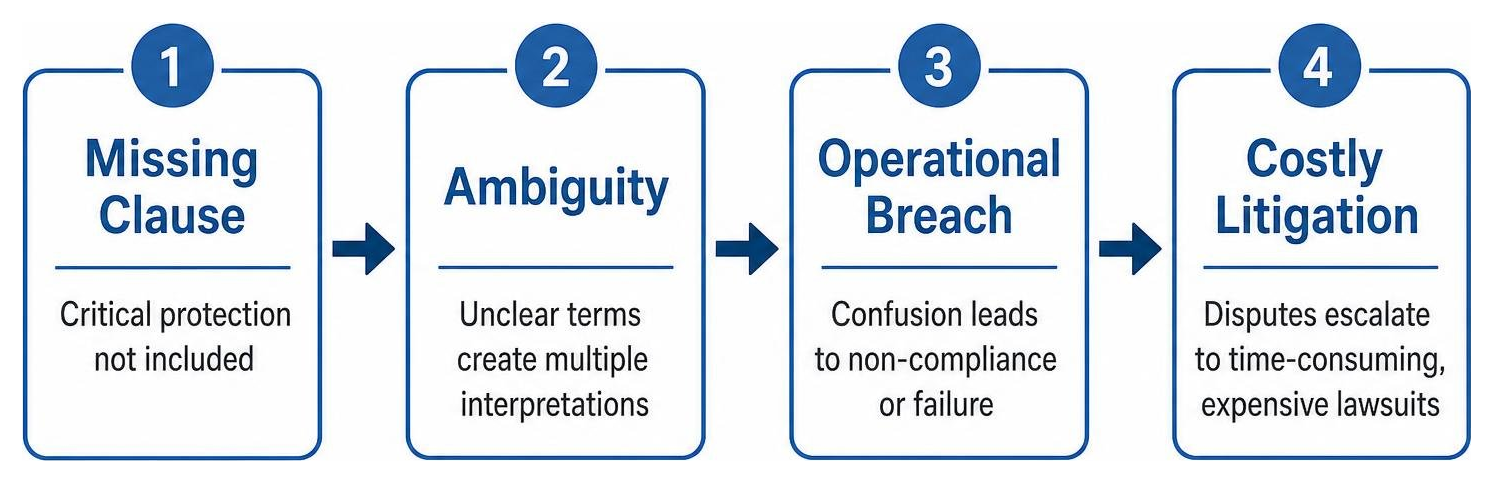
The most dangerous agreement is often the one that appears complete on the surface. Standard templates regularly omit essential protective mechanisms that become visible only after a dispute arises or due diligence begins during an acquisition.
Limitation of Liability and Indemnification Safeguards
A significant vulnerability in unvetted agreements is the absence of an enforceable limitation of liability. Without clear boundaries, a company can face uncapped exposure for consequential, incidental, or special damages stemming from an ordinary breach.
Comprehensive drafting establishes clear safeguards:
- Aggregate Liability Caps: Tying maximum financial exposure directly to the total fees paid under the contract over a defined period (such as the preceding 12 months).
- Mutual Consequential Damage Waivers: Explicitly disclaiming lost profits, loss of business reputation, and indirect damages.
- Calibrated Indemnification: Defining the scope of third-party claims, defense obligations, notice timelines, and explicit carve-outs (such as gross negligence or willful misconduct).
Leaving these clauses unaddressed or copying generic boilerplate can leave a business exposed to enterprise-threatening liabilities over routine operational missteps.
Comprehensive Intellectual Property Assignment and Work-for-Hire Terms
A common misconception among business owners is assuming that paying an independent contractor or vendor for custom work automatically grants full ownership of the resulting intellectual property. Under federal copyright law, the “work-made-for-hire” doctrine applies only to specific categories of works and relationships.
If an agreement fails to include explicit, present-tense assignment language (“hereby assigns”), the legal ownership of proprietary software, designs, manufacturing processes, or marketing assets may remain with the contractor. When preparing for institutional investment, a major loan, or a corporate sale, discovering unassigned intellectual property can stall or derail the entire transaction.
3. Essential Benefits of Engaging Professional Contract Drafting Services
Hiring dedicated legal counsel to prepare commercial agreements delivers long-term stability and commercial certainty. High-quality drafting aligns your daily operations with current statutory requirements, minimizing downstream friction and protecting your operational freedom.
For regional enterprises, understanding corporate governance and legal structuring in Texas is critical when drafting operational contracts that must withstand scrutiny under state corporate law.
Navigating Jurisdiction-Specific Enforceability and Governing Law
Contract enforceability varies significantly across state lines and industry sectors. What is fully enforceable in one state may be void against public policy in another.
- Restrictive Covenants: Non-compete and non-solicitation clauses are subject to strict statutory standards that evolve rapidly. In Texas, covenants not to compete must be ancillary to an otherwise enforceable agreement and reasonable in time, geographical area, and scope of activity.
- Choice of Law and Venue Provisions: Standard contracts often select random jurisdictions that force local businesses to litigate thousands of miles away under unfamiliar statutes.
- Statutory Construction Rules: Local courts interpret liability limitations, indemnity obligations in oilfield services, and construction contingencies under specific statutory frameworks that generic templates consistently ignore.
Professional drafting ensures that choice of law, forum selection, and dispute resolution mechanisms reflect where your operations occur and where your assets reside.
Integrating Hybrid Workflows for In-House Legal Scalability
As corporate legal departments face rising contract volumes without expanding internal headcounts, adopting hybrid workflows has become a practical approach. In-house teams can scale routine contract demands by combining modern efficiency tools with outside counsel for high-risk, bespoke transactions.
This hybrid structure divides contract workflows efficiently:
- First-Pass Acceleration: Automated platforms extract deal points, check baseline playbooks, and assemble standard agreements like NDAs or vendor forms in minutes.
- In-House Governance: Internal counsel manages routine modifications, tracks business approvals, and monitors corporate operational standards.
- Strategic Outside Counsel: Complex cross-border matters, novel entity structuring, high-liability transactions, and regulatory compliance remain with experienced transactional attorneys.
This balance compresses turnaround times while maintaining rigorous legal standards on critical agreements.
4. How Modern Legal Teams Evaluate AI-Assisted Drafting Tools and Workflows
Technology-enabled law practices evaluate digital drafting tools through strict regulatory, ethical, and governance frameworks. The adoption of generative platforms within corporate legal departments requires adherence to standards like the NIST AI Risk Management Framework and the American Bar Association’s Formal Opinion 512, which governs professional responsibility, competence, and confidentiality.
Selecting Technology-Enabled Contract Drafting Services for Consistency
When legal teams incorporate technology into their practice, they evaluate platforms on their ability to enforce structural consistency rather than simply generating unverified prose. Modern precedent-based drafting workflows allow legal teams to map term sheets directly to established corporate playbooks, catching missing clauses and outdated terms early in the process.
Modern technology-assisted drafting workflows provide:
- Playbook Compliance Tracking: Highlighting departures from your preferred negotiation fallback positions.
- Automated Risk Scoring: Pinpointing unvetted indemnities, ambiguous payment milestones, or missing termination clauses.
- Data Moderation Layers: Scrubbing proprietary and identifying information before text enters external processing pipelines.
Preserving Institutional Knowledge and Clause Provenance
A common problem for growing companies is institutional drift—where negotiated concessions and custom drafting revisions become lost across disparate email chains and redlined Word documents.
Modern legal drafting systems address this by maintaining a centralized, verified clause library. By tracking clause provenance (the documented history and justification for why specific language was adopted), attorneys preserve corporate memory. When an agreement comes up for renewal or renegotiation, counsel can review prior fallback positions and understand the commercial rationale behind every provision.
5. Strategic Long-Term Advantages of Attorney-Led Commercial Agreements
Investing in professionally prepared contracts is an investment in your company’s long-term balance sheet. Clean, precise agreements establish stability across vendor networks, customer relationships, and strategic partnerships.
Mitigating Litigation Exposure Before Disputes Arise
The primary goal of precise contract drafting is to prevent litigation altogether. Lawsuits often stem from linguistic ambiguity—vague phrases such as “reasonable efforts,” “timely delivery,” or undefined “material breaches” that invite competing interpretations when commercial relationships sour.
By defining unambiguous obligations, establishing tiered notice-and-cure periods, and including clear fee-shifting provisions for prevailing parties, tailored contracts remove the financial incentives for counterparties to pursue speculative legal claims.
Accelerating Deal Cycles and Due Diligence Readiness
During mergers, capital raises, or asset acquisitions, prospective buyers and lenders conduct exhaustive due diligence on your commercial agreements. Missing liability caps, unassigned intellectual property, ambiguous change-of-control provisions, and disorganized contract repositories create immediate red flags that can depress valuations or delay closing.
Attorney-drafted contracts ensure your core operational agreements are structured cleanly from day one, allowing deals to progress smoothly without last-minute contract remediation.
Frequently Asked Questions About Contract Drafting Services
What is the difference between contract drafting and contract review?
Contract drafting involves building an agreement from the ground up, starting with discovery, fact-finding, deal structuring, and tailored language that reflects your commercial goals. Contract review is the analysis of an agreement provided by a counterparty to identify risks, evaluate one-sided language, suggest redlines, and negotiate favorable revisions before execution.
How quickly can custom business contracts be drafted?
Turnaround times depend on the complexity of the underlying transaction. Standard business contracts (such as non-disclosure agreements, independent contractor agreements, and standard vendor forms) can typically be completed within 24 to 48 hours. Complex commercial transactions, master service agreements, joint venture agreements, or multi-party corporate restructuring documents generally require 3 to 5 business days to allow for thorough risk analysis and strategy alignment.
When should a business transition from templates to professional drafting?
A business should move beyond templates as soon as transactions involve meaningful financial exposure, proprietary intellectual property, complex regulatory requirements, or non-standard commercial terms. Relying on generic downloads once your enterprise begins hiring key employees, managing vendor relationships, or licensing proprietary assets introduces unmanaged legal and operational risks.
Build Enforceable, Defensible Commercial Agreements
A successful commercial contract aligns with your operational realities, protects your financial interests, and minimizes dispute risks. Relying on generic templates or unverified automated drafts leaves your company exposed to enforceability gaps, unassigned intellectual property, and uncapped liability.
At Brad J. Davidson Law Firm, PC, we provide strategic, responsive transactional legal representation to businesses throughout West Texas and New Mexico. From commercial contract creation and master service agreements to entity structuring and dispute avoidance, we ensure your business agreements are clear, defensible, and built for growth.
If you need experienced counsel to draft, review, or negotiate your critical business contracts, connect with our team of experienced civil litigation and contract attorneys in Midland-Odessa to protect your commercial interests.


