

Texas Statutes of Limitations and Repose in Construction Defect Cases
When dealing with structural failures, water leaks, or substandard materials, understanding the statutory clock is vital. Under Texas law, your right to recover damages is governed by two separate statutory mechanisms: the statute of limitations and the statute of repose. Failing to recognize the difference between them can permanently extinguish your right to legal relief.
The statute of limitations sets a deadline based on when a legal claim accrues. Under the Texas Civil Practice and Remedies Code, different causes of action carry distinct filing windows:
- Tort and Deceptive Trade Practices: Claims grounded in negligence, gross negligence, or violations of the Texas Deceptive Trade Practices-Consumer Protection Act (DTPA) generally carry a two-year statute of limitations.
- Contract and Express Warranty: Claims for breach of written contract or breach of express warranty generally carry a four-year statute of limitations.
- Fraud and Fraudulent Concealment: Fraud actions also generally fall under a four-year limitations period.
The interplay between these deadlines becomes crucial when multiple claims arise from the same construction failure. In Eric C. Hixon and Beverly Hixon v. Pedigo Services, the Texas Court of Appeals examined how homeowners faced significant limitations hurdles after suffering water intrusion from defective Exterior Insulation and Finish System (EIFS) cladding. The court highlighted that when a property owner discovers the underlying damage, the limitations clock begins ticking for each specific legal theory. Furthermore, a contractor’s ongoing, unsuccessful repair attempts do not automatically pause or toll the limitations period for underlying warranty claims.
Distinct from the statute of limitations, the Texas statute of repose provides an absolute outer boundary for filing construction claims, regardless of when you discovered the defect. Generally found in Chapter 16 of the Texas Civil Practice and Remedies Code, the statute of repose cuts off builder, engineer, and architect liability after a specified number of years (typically 10 to 12 years, subject to statutory amendments and specific contract terms) following substantial completion of the improvement. Once the repose period expires, no lawsuit can be filed—even if the defect was completely hidden until that point.
Applying the Discovery Rule to a Lubbock Construction Defect Lawsuit
Property owners often ask whether they are barred from filing suit if a defect takes years to reveal itself. This is where the discovery rule comes into play. Under Texas law, the discovery rule is a narrow exception that pauses or tolls the accrual of the statute of limitations until the injured party knew, or through the exercise of reasonable diligence should have known, of the facts giving rise to the cause of action.
To invoke the discovery rule, the legal injury must typically be:
- Inherently undiscoverable within the statutory limitations window.
- Objectively verifiable by physical and forensic evidence.
The nuances of this doctrine were closely analyzed in Morningside Ministries v. Koontz McCombs Construction. In that dispute, a senior living facility suffered severe moisture intrusion, wall puckering, and structural movement years after project delivery. The owner incurred forensic investigation expenses exceeding $685,700 to diagnose systemic failures hidden deep behind the building’s exterior envelope.
The court evaluated whether the latent building defects were inherently undiscoverable without destructive testing and specialized engineering analyses. As the ruling demonstrated, property owners must prove they acted with reasonable diligence the moment initial warning signs (such as unexplained drywall cracks, minor leaks, or trim separation) appeared. If an owner ignores visible symptoms, Texas courts may rule that the injury was discoverable, starting the limitations clock earlier than the owner intended.
Complying with the Texas Residential Construction Liability Act
If your claim involves a single-family home, duplex, condominium, or other residential real estate, your lawsuit is subject to the Texas Residential Construction Liability Act (RCLA), codified in Chapter 27 of the Texas Property Code. The RCLA does not create an independent cause of action; rather, it imposes mandatory pre-suit procedural requirements that govern any lawsuit seeking damages from a builder or contractor for construction defects.
The RCLA process follows a strict procedural sequence:
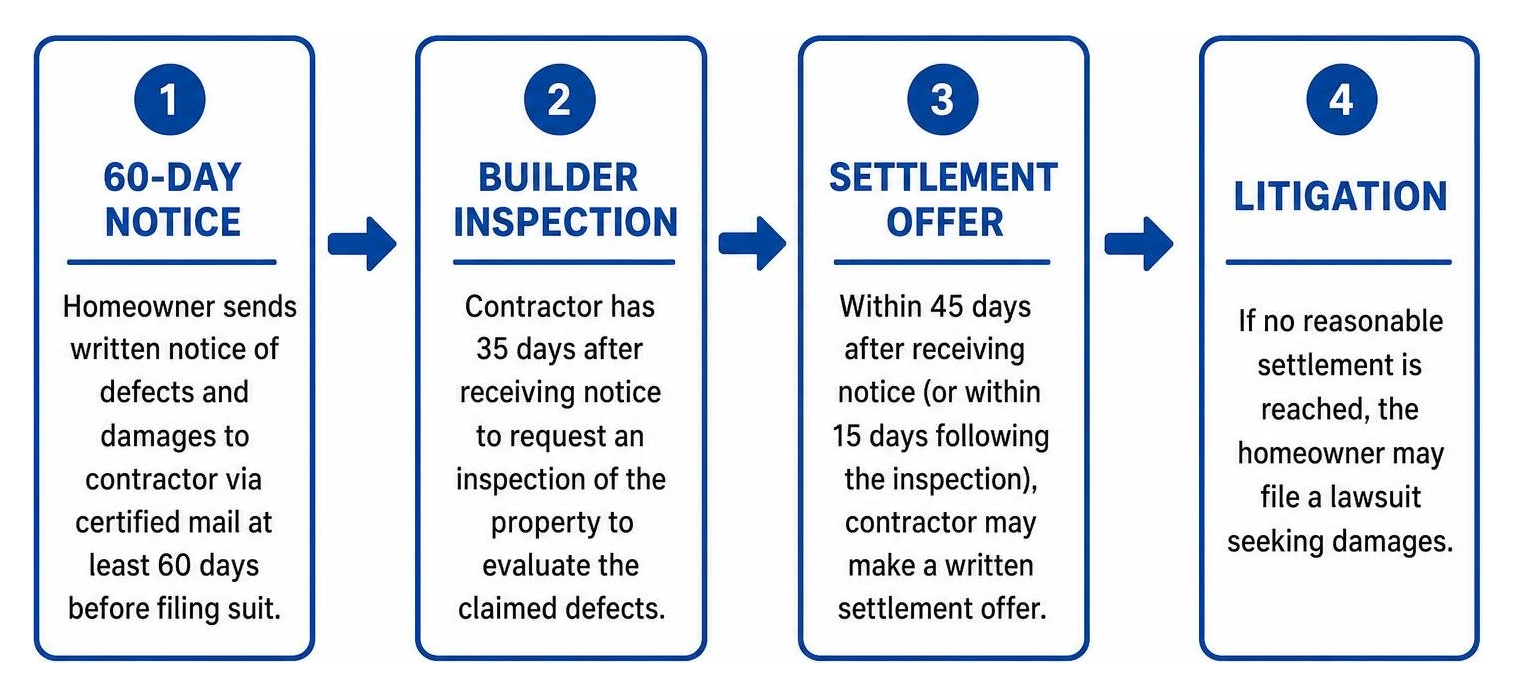
Key steps mandated by the RCLA include:
- Written Notice of Claim: At least 60 days before filing a lawsuit, the homeowner must provide written notice to the contractor via certified mail, describing the construction defects and resulting damages in reasonable detail.
- Pre-Suit Inspection: The contractor has 35 days after receiving the notice to request an inspection of the property to evaluate the claimed defects.
- Settlement Offer: Within 45 days after receiving the notice (or within 15 days following the inspection), the contractor may make a written settlement offer, which may include an offer to repair the defects or pay a cash settlement.
- Reasonableness Standard: If the homeowner rejects an offer that a court or arbitrator later determines was “reasonable,” the homeowner’s recovery for damages and attorney fees is strictly capped under the statute.
Complying with the RCLA requires precision. Serving an incomplete or late notice can stall your case, delay repairs, and compromise your ability to recover legal costs.
Grounds for Filing a Lubbock Construction Defect Lawsuit
A successful construction defect lawsuit rarely rests on a single legal theory. Depending on the contracts signed, warranties issued, and conduct of the builders, property owners often assert multiple overlapping claims.

| Legal Claim | Statute of Limitations | Key Elements Required | Available Remedies |
|---|---|---|---|
| Breach of Contract | 4 Years | Valid agreement, owner performance, builder non-performance, resulting damages. | Cost of repair, completion expenses, incidental damages, attorney fees. |
| Breach of Express Warranty | 4 Years | Explicit promise regarding quality/materials, failure to conform, timely notice. | Remediation costs, difference in value, contractual remedies, attorney fees. |
| Negligence / Workmanship | 2 Years | Legal duty, breach of ordinary care, proximate causation, physical property damage. | Actual property damages, remediation expenses (subject to economic loss rule). |
| DTPA Violation | 2 Years | Consumer status, deceptive or unconscionable act, reliance, producing cause of harm. | Economic damages, mental anguish (if intentional), treble damages, mandatory fees. |
Breach of Contract and Express Warranty Claims
The cornerstone of most construction litigation is the written agreement between the owner and the prime contractor. When a builder fails to follow construction drawings, deviates from engineering specifications, or substitutes inferior materials, they breach the contract.
In addition to pure contract claims, owners frequently enforce express warranties regarding quality and performance. In McAllen State Bank v. Linbeck Construction Corp., a commercial building owner faced catastrophic skylight, expansion joint, and roof leaks following a severe storm. The court upheld substantial damage awards—including $960,000 in actual repair damages alongside liquidated damages for delay—because the builder had expressly warranted that the work would be free from faults, executed in a good and workmanlike manner, and constructed with suitable materials.
The case also confirmed that detailed business records, itemized invoices, and expert testimony on the necessity of remediation are fully admissible to establish the reasonable value of corrective repairs.
Deceptive Trade Practices and Builder Misrepresentation
The Texas Deceptive Trade Practices-Consumer Protection Act (DTPA) provides potent remedies when a builder, seller, or developer engages in false, misleading, or deceptive business practices.
Under the DTPA, property owners may pursue claims when a contractor:
- Represents that work or services are of a particular standard, quality, or grade when they are not.
- Misrepresents architectural plans, drainage capabilities, or foundation designs.
- Fails to disclose known material defects with the intent to induce the buyer into a transaction.
Builders frequently attempt to shield themselves from liability by inserting “as-is” clauses into purchase and sale contracts. However, Texas courts enforce clear boundaries against builder overreach. In Kupchynsky v. Nardiello, home buyers discovered severe moisture intrusion on their balcony because the builder installed cheap, galvanized metal drainage pans (which corroded within months) instead of permanent copper pans, while failing to follow engineered drainage details.
The appellate court held that an “as-is” clause will not insulate a builder from DTPA liability when the builder makes affirmative misrepresentations regarding construction quality or conceals known construction flaws. When knowing or intentional violations are proven, the DTPA permits plaintiffs to recover up to three times their actual economic damages, along with mandatory court costs and attorney fees.
How to Build and File Your Construction Defect Claim
Litigating a construction defect case requires an organized, evidence-based approach. Because construction disputes hinge on engineering data and material science, laying the groundwork early determines whether a case settles favorably or struggles at trial.

Preserving Evidence and Conducting Forensic Engineering Inspections
When physical defects surface, property owners must carefully document the condition before performing destructive repairs or alterations. Altering the property without proper documentation can lead to claims of evidence spoliation.
To establish liability and damages, we recommend taking the following actions immediately:
- Maintain a Comprehensive Defect Log: Record dates, weather conditions, water intrusion points, cracking patterns, and any changes over time.
- Retain Qualified Forensic Engineers: Independent structural, geotechnical, and building envelope experts must inspect the site, evaluate subgrade soils, test moisture content, and perform non-destructive and core sampling.
- Preserve Repair Records: Keep every invoice, bid, change order, payment receipt, and piece of contractor correspondence.
The necessity of thorough expert inspection was underscored in Krupar, J.M. Construction Company, Inc. v. Wade R. Rosenberg. In that case, a homeowner noticed wall and slab movement, prompting multiple engineering evaluations that eventually revealed a critical missing structural foundation pad. The homeowner secured substantial damages, including $165,000 for reduction in market value, $314,673 for past repairs, $30,000 for future repairs, and $250,000 in additional statutory damages under the DTPA, backed by over $350,000 in attorney fees. The appellate decision affirmed that comprehensive engineering reports and timely core testing are foundational to proving technical construction defects in court.
Navigating Municipal Codes and Local Enforcement Actions
Construction projects in Lubbock must strictly comply with local building codes, structural standards, and municipal permitting processes. When a construction project experiences major defects or stalls due to contractor default, the local municipality may step in.
The legal dynamics between local code enforcement, building stalls, and property rights were demonstrated in City of Lubbock v. Corbin. When a residential construction project sat incomplete for years with safety violations, the City of Lubbock issued stop-work tags and initiated demolition proceedings through the Housing Standards Commission.
While the property owners attempted to assert civil rights claims under 42 U.S.C. § 1983 against the city, the Texas Court of Appeals reversed the jury’s $303,000 civil rights verdict, holding that routine municipal building code enforcement and nuisance abatement do not constitute constitutional violations. For property owners and contractors alike, the lesson is clear: construction defect disputes must be addressed proactively through established civil litigation and administrative code procedures before municipal authorities intervene with stop-work orders or nuisance declarations.
Potential Remedies and Financial Recovery in Defect Litigation
The objective of a construction defect lawsuit is to make the property owner whole by restoring the financial and structural value of the real estate.
Key Damages Recoverable in a Lubbock Construction Defect Lawsuit
Depending on the causes of action asserted and the findings of the court, recoverable damages typically include:
- Reasonable and Necessary Cost of Repairs: The actual financial expense required to remediate structural deficiencies, waterproof the building envelope, replace defective roofing, and repair interior cosmetic damage.
- Diminution in Market Value: If the property suffers permanent structural stigma or cannot be completely restored to its intended value even after repairs, owners can recover the difference in fair market value.
- Temporary Housing and Relocation Costs: Reasonable living expenses incurred if residents must vacate the home during invasive structural remediation.
- Engineering and Consulting Expenses: Fees paid to forensic engineers, testing laboratories, and moisture mapping specialists to diagnose the root cause of the failure.
- Attorney Fees and Court Costs: Available under Chapter 38 of the Texas Civil Practice and Remedies Code for contract claims, Chapter 27 of the Texas Property Code (RCLA), and Chapter 17 of the Texas Business and Commerce Code (DTPA).
Understanding the Economic Loss Rule and Subcontractor Liability
Navigating construction defect claims requires understanding the economic loss rule. Under Texas jurisprudence, if a defect causes damage solely to the subject matter of the contract itself (the building or work performed) and causes no personal injury or damage to other separate property, the plaintiff’s remedy sounds exclusively in contract rather than in tort (negligence).
This rule often prevents property owners from suing subcontractors directly for pure negligence when there is no direct contractual privity between the owner and the trade contractor. Instead, the general contractor remains directly accountable to the owner under the prime contract, and the general contractor must subsequently pursue indemnity or contribution claims against the responsible trade contractors.
Furthermore, where oral agreements, disputed scope additions, or missing price terms arise between builders and subcontractors, Texas courts utilize equitable doctrines such as quantum meruit to determine the reasonable market value of labor and materials provided, ensuring that liability and compensation are distributed fairly based on industry standards.
Frequently Asked Questions About Texas Construction Defect Claims
When does the statute of limitations begin for construction defect claims in Texas?
The statute of limitations generally begins on the date the breach or wrongful act occurs. However, under the Texas discovery rule, the accrual date may be deferred until the property owner discovered, or through the exercise of reasonable diligence should have discovered, the existence of the injury. For visible issues, the clock starts when warning signs first appear.
Can an “as-is” contract clause protect a builder from construction defect liability?
No, an “as-is” clause does not provide absolute immunity. Under Texas law, an “as-is” provision is unenforceable if the builder or seller engaged in fraudulent inducement, made affirmative misrepresentations concerning the property’s quality or plans, or concealed known material defects in violation of the Texas Deceptive Trade Practices Act.
What constitutes an “inherently undiscoverable” construction defect?
An “inherently undiscoverable” defect is a physical failure or design flaw that an owner could not reasonably detect through ordinary visual inspection at the time of completion. Examples include improper foundation pier depth, missing moisture barriers inside sealed wall cavities, concealed plumbing leaks under concrete slabs, or substandard framing anchors hidden behind drywall.
Conclusion
Construction defects compromise the structural stability, safety, and market value of your real estate investment. Because Texas law enforces strict two-year and four-year statutory deadlines alongside complex pre-suit RCLA notice requirements, delaying action can permanently bar your financial recovery.
Protecting your investment demands immediate evidence preservation, thorough forensic engineering, and aggressive legal advocacy. If your residential or commercial property is suffering from structural cracking, moisture intrusion, or substandard workmanship, consult an experienced Lubbock civil litigation attorney to evaluate your contracts, calculate your statutory deadlines, and assert your legal rights before the clock runs out.


