

Understanding How Business Mediation Services Differ from Litigation and Arbitration
Business mediation services keep corporate disputes out of court by providing a structured, confidential, and voluntary negotiation process. A neutral mediator facilitates direct dialogue between the parties, helping them identify underlying commercial interests and craft a mutually agreeable settlement. Because the parties retain complete autonomy over whether to sign an agreement, the process yields self-determined business solutions that no court or arbitrator has the legal authority to mandate.
When commercial friction surfaces, companies face three primary paths: courtroom litigation, binding arbitration, or mediation. Understanding the structural differences among these options is crucial for protecting operational capital, preserving executive focus, and maintaining control over the outcome.
Litigation is an adversarial, public process. In civil court, opposing parties surrender final decision-making power to a judge or jury. The discovery phase can drag on for months or years, requiring extensive document production, depositions, and motions. The proceedings become matters of public record, exposing sensitive financial data, customer lists, and internal communications to public scrutiny.
Arbitration is often described as private litigation. While it takes place outside a public courtroom, it remains an adversarial proceeding where an arbitrator or panel of arbitrators acts as a private judge. The arbitrator hears evidence, reviews testimony, and issues an award that is typically binding and enforceable, with virtually no avenue for appeal. The parties forfeit control over the final remedy, and costs can rival traditional litigation once administrative and arbitrator fees accrue.
In contrast, mediation is a voluntary, non-adversarial process facilitated by a neutral third party. The mediator holds no authority to impose a binding order or declare a winner. Instead, their role is to guide the parties through structured negotiation, uncover root commercial interests, and help both sides craft a mutually agreeable settlement.
| Feature | Courtroom Litigation | Binding Arbitration | Business Mediation |
|---|---|---|---|
| Control Over Outcome | Lost; decided by judge or jury | Lost; decided by arbitrator | Retained entirely by the disputing parties |
| Formality & Setting | Formal, public courtroom setting | Semi-formal, private tribunal setting | Informal, structured, confidential setting |
| Privacy & Records | Public court records and filings | Private proceedings; limited public access | Strictly confidential by statute and agreement |
| Average Timeline | 12 to 24+ months | 6 to 18 months | Typically 1 to 4 sessions (days or weeks) |
| Financial Cost | High; substantial discovery and legal fees | Moderate to high; hourly arbitrator and administrative fees | Low to moderate; shared mediator fee, minimal discovery |
| Relational Impact | High risk of relationship destruction | Adversarial; often severs commercial ties | High potential for relationship preservation |
| Remedy Flexibility | Limited to statutory and legal damages | Limited to monetary or defined contractual remedies | Highly flexible; custom business arrangements, debt restructuring, revised terms |
The Core Advantages of Commercial Mediation
Choosing mediation provides immediate strategic advantages for commercial enterprises navigating complex disputes. Rather than allocating capital to protracted discovery disputes, companies can target rapid, practical resolution.
- Substantial Cost Reductions: Traditional civil litigation can drain operational budgets. Legal fees, expert witness costs, court reporters, e-discovery management, and trial preparation quickly escalate. Mediation resolves disputes at a fraction of the cost because it avoids extensive motion practice and prolonged discovery battles.
- Speed and Executive Time Recovery: Commercial litigation routinely takes one to two years to reach a trial date, during which executives and key personnel remain distracted by depositions, document holds, and court schedules. Most business mediations conclude within one to four focused sessions, allowing management to redirect attention back to core operations and quarterly performance targets.
- Guaranteed Confidentiality and Trade Secret Protection: Public litigation invites public scrutiny, competitor insight, and reputational risk. In mediation, discussions, position papers, proposed concessions, and financial revelations are protected by strict statutory confidentiality rules. Sensitive pricing models, intellectual property disclosures, and internal margins remain private.
- Creative and Tailored Commercial Outcomes: Courts are generally restricted to awarding monetary damages or standard injunctive relief. Mediation allows business leaders to construct bespoke commercial solutions that legal statutes cannot order. Disputing entities can negotiate revised delivery timelines, modified payment schedules, equity buyouts, restructured licensing terms, or multi-year vendor renewals that transform a contentious impasse into a functional business arrangement.
How Business Mediation Services Protect Working Relationships
In sectors like energy, commercial real estate, agriculture, and manufacturing across West Texas and New Mexico, business communities thrive on interconnected networks. Once a company files a formal lawsuit against a critical supplier, joint operating partner, or commercial landlord, the underlying working relationship is often permanently fractured.
Mediation reframes dispute resolution from an adversarial zero-sum contest into an interest-based problem-solving exercise. Instead of arguing about who bears technical blame under legal doctrine, a skilled mediator guides the parties to discuss their underlying commercial objectives. A vendor may simply require predictable cash flow to maintain payroll, while a buyer might need restructured delivery intervals to manage warehouse capacity.
By prioritizing direct dialogue and confidential caucusing, mediation shields business leaders from the hostility typical of courtroom battles. Companies can resolve immediate disputes while preserving vital supply chains, customer accounts, and strategic alliances that took decades to build. For a broader understanding of how alternative dispute resolution fits within the civil justice system, see this overview of mediation.
Common Commercial Disputes Best Suited for Mediation
Not every legal disagreement belongs in a courtroom. Many corporate conflicts stem from misaligned expectations, sudden market shifts, or communication breakdowns that are well-suited for early mediation.

Resolving Vendor, Billing, and Service Contract Disputes
Vendor and service disagreements represent a significant share of day-to-day business conflicts. A commercial client may withhold payment due to alleged deficiencies in equipment installation or service scope, while the contractor asserts full performance under the original invoice. Unchecked, these disagreements often lead to formal Better Business Bureau (BBB) complaints, mechanic’s liens, or aggressive collection actions that damage corporate reputations.
Consider an HVAC service dispute involving a multi-unit commercial property: the property owner claims improperly installed rooftop units caused water intrusion and inventory loss, refusing to pay a $45,000 final balance, while the contractor demands immediate payment plus statutory late interest under commercial payment rules.
In mediation, rather than spending $50,000 in legal fees arguing over comparative fault, the parties can construct a balanced compromise: the contractor performs targeted remediation under a defined warranty schedule, the property owner releases a negotiated portion of the funds immediately, and both parties sign a mutual release of claims. The business avoids public BBB complaints, resolves its accounts receivable, and preserves an operational vendor relationship.
Navigating Partnership Dissolution and Shareholder Conflicts
Disagreements among co-owners, business partners, and equity shareholders can threaten the operational viability of an enterprise. These disputes are often deeply personal, involving competing visions for company growth, disagreements over executive compensation, disputes over capital contributions, or deadlocks on board votes.
When co-founders decide to separate, a public judicial dissolution can force an untimely fire-sale liquidation of corporate assets, severely devaluing the business. Mediation offers a private forum to negotiate comprehensive separation agreements. The neutral mediator assists the parties in:
- Structuring tax-efficient equity buyouts using deferred promissory notes or staged earn-outs.
- Dividing commercial assets, proprietary tools, intellectual property licenses, and client accounts without destroying operational continuity.
- Establishing reasonable, enforceable non-compete, non-solicitation, and confidentiality parameters tailored to regional markets.
- Releasing mutual fiduciary claims, preventing future litigation, and enabling both owners to pursue their independent commercial ventures cleanly.
Step-by-Step Guide: How to Prepare for and Navigate the Mediation Process
Approaching mediation with a structured, methodical strategy significantly increases the likelihood of reaching an advantageous settlement. Mediation is a disciplined negotiation process that requires clear preparation.
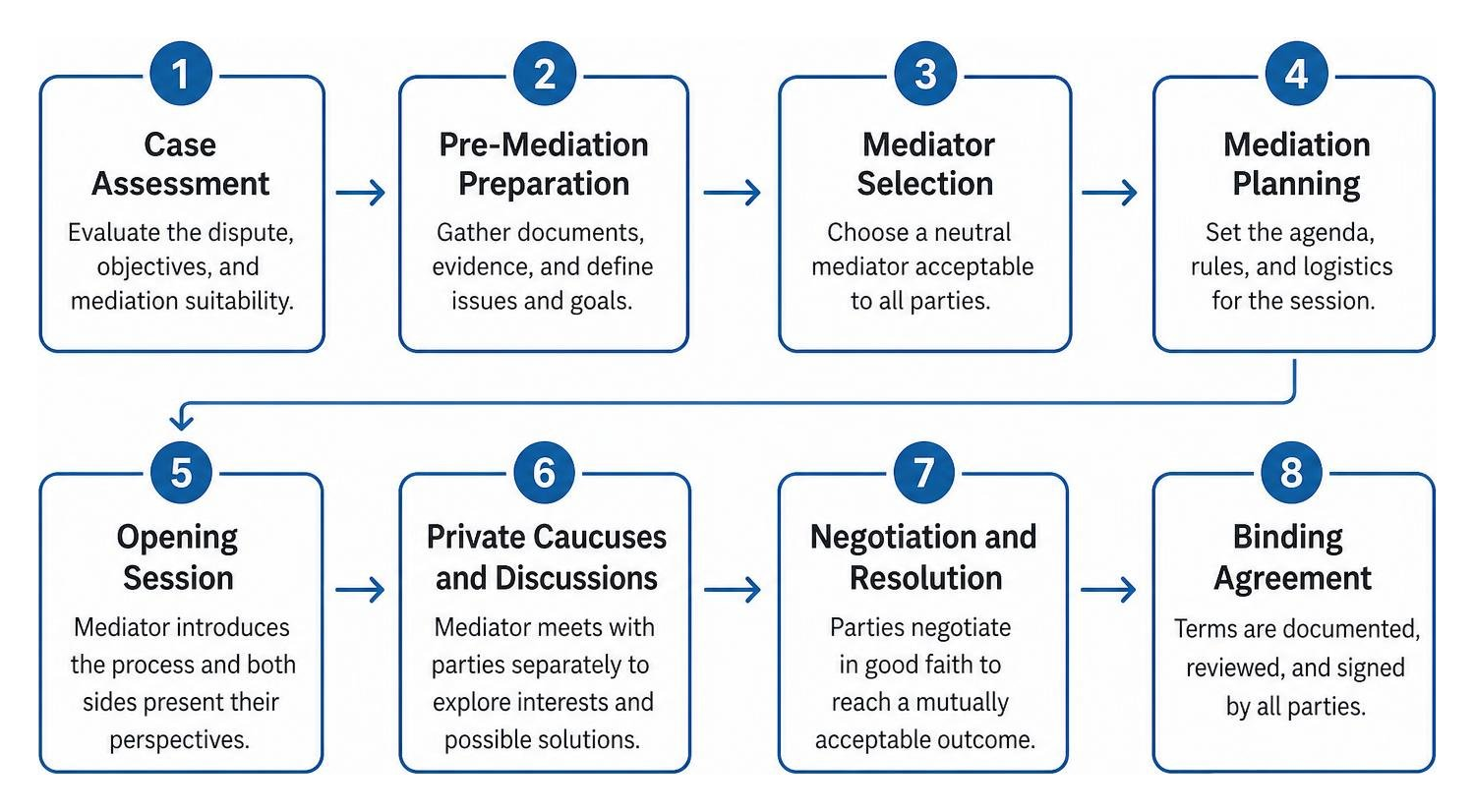
Pre-Mediation Preparation and Information Gathering
Preparation is the foundation of a successful mediation. Entering a session without organized documentation and a clear negotiation range limits your ability to evaluate offers or structure creative alternatives.
- Conduct a Thorough Document and Evidence Audit: Gather all relevant contracts, master service agreements, change orders, email correspondence, payment logs, inspection reports, and accounting ledgers. Identify the precise contractual clauses and performance milestones that form the basis of the dispute.
- Clarify Commercial Objectives vs. Bottom-Line Positions: Separate what you must achieve from what you prefer to achieve. Determine your Best Alternative to a Negotiated Agreement (BATNA). Calculate the true financial and operational cost of walking away from mediation and proceeding through full-scale litigation, including attorney fees, expert expenses, discovery burdens, and potential market disruption.
- Draft a Comprehensive Confidential Position Statement: Most mediators require the parties to submit a pre-mediation brief. This document should succinctly summarize the factual background, core contractual terms, legal theories, and financial damages. It should also outline past settlement discussions and identify realistic commercial terms that could facilitate an agreement.
- Assemble the Right Negotiation Team with Full Settlement Authority: Ensure that your designated organizational representatives have complete corporate authority to execute a binding settlement. Sending representatives who must continually call outside executives for approval undermines negotiation momentum and can stall progress.
The Mediation Session: Joint Discussions, Caucuses, and Settlement Terms
A standard business mediation follows an established procedural rhythm designed to encourage open communication while protecting strategic positions.
- Joint Opening Session: The mediator convenes all participants, explains the ground rules, and reaffirms the statutory confidentiality of the proceeding. Counsel or designated executive leaders may present a brief, professional opening statement framing their perspective on the commercial dispute without aggressive rhetoric.
- Private Caucus Sessions: Following the joint session, the parties separate into private conference rooms (or secure virtual breakout rooms). The mediator shuttles between rooms to discuss the strengths, weaknesses, and financial realities of each side’s case. Information shared in caucus remains strictly confidential; the mediator will not disclose details to the other party without explicit permission.
- Interest-Based Negotiation and Shuttle Diplomacy: The mediator tests settlement scenarios, delivers counteroffers, and challenges unreasonable assumptions. By filtering out emotional posturing and personal grievances, the mediator helps both parties focus on practical trade-offs, risk mitigation, and commercial solutions.
- Execution of a Binding Settlement Agreement: Once the parties reach conceptual terms, counsel drafts a formal Settlement Agreement or binding Memorandum of Understanding (MOU). This document outlines payment amounts, operational deliverables, intellectual property terms, mutual releases of liability, and dismissal of any pending actions. Once signed by all parties, it becomes a legally binding, enforceable contract.
Key Factors in Choosing the Right Business Mediator
The selection of your mediator directly influences the efficiency and outcome of the dispute resolution process. An effective commercial mediator requires more than general dispute resolution credentials; they need deep familiarity with business operations and commercial law.
Evaluating Legal Expertise and Industry Experience
When vetting a mediator for a corporate, contractual, or real estate conflict, look for key credentials and capabilities:
- Substantive Commercial Legal Knowledge: A mediator with a Juris Doctor (JD) and extensive commercial litigation background brings an understanding of contract interpretation, civil procedure, statutory liability, and court risk. They can realistically assess how a judge or jury would view specific claims, which helps temper unrealistic expectations on both sides.
- Practical Industry and Operational Insight: Mediators who understand entity structures, corporate governance, balance sheets, supply-chain logistics, and regional economic dynamics can grasp complex disputes quickly. For instance, in West Texas and New Mexico commercial disputes, familiarity with oilfield master service agreements, commercial real estate leases, and regional trade practices prevents delays in explaining basic industry terminology.
- Process Mastery and Facilitative Skill: Strong business mediators balance facilitative problem-solving with evaluative insight. They know when to let parties voice frustrations, when to intervene to keep negotiations constructive, and how to structure creative settlement options when talks hit an apparent impasse.
- Impartiality and Uncompromising Ethics: The mediator must be completely free of prior professional conflicts with all parties, their corporate affiliates, and their legal counsel. Clear, unbiased neutrality is essential for building the trust needed to navigate tough compromises.
Maximizing Business Mediation Services Through Authentic Leadership
Mediation is not merely a legal tactic; it is an extension of effective executive leadership. Internal workplace conflicts, executive compensation disputes, and departmental deadlocks can undermine productivity, drain employee morale, and stifle operational innovation.
Research in organizational behavior demonstrates that authentic leadership—characterized by transparent communication, self-awareness, and ethical decision-making—builds organizational trust and employee empowerment. When corporate leaders establish structured, peer-mediated resolution channels and address disputes early, employees develop stronger organizational identification.
Instead of cultivating a defensive, risk-averse workplace culture, companies that embrace mediation empower their teams to solve problems collaboratively. Intrapreneurial initiative flourishes when staff members know that commercial disagreements and operational friction are met with constructive, interest-based problem-solving rather than punitive escalation.
Frequently Asked Questions About Business Mediation
Is a settlement reached through business mediation legally binding?
Yes. While the mediation process itself is voluntary and non-binding, the moment both parties reach an agreement and execute a written Settlement Agreement or binding Memorandum of Understanding, that document becomes a legally binding contract.
In jurisdictions across Texas and New Mexico, properly executed settlement agreements are enforceable in civil court under standard contract law. If one party subsequently breaches the terms of the agreement—such as failing to make a scheduled payment or violating an agreed non-solicitation clause—the non-breaching party can file an enforcement action to compel compliance and seek contractual damages.
How long does the business mediation process typically take?
Business mediation is considerably faster than courtroom litigation. Most commercial mediations conclude within a single full-day session or a series of two to four targeted sessions spanning a few weeks. The overall timeline depends on the complexity of the underlying claims, the volume of financial discovery required, and the willingness of the parties to engage in good-faith negotiations.
Even complex multi-party disputes involving commercial leases, vendor agreements, or shareholder buyouts rarely exceed two to three months from initial intake to final agreement execution—compared to the 12 to 24 months typically required to bring a commercial lawsuit to trial.
What happens if the parties fail to reach an agreement during mediation?
If the parties reach a genuine impasse and cannot agree on settlement terms, they forfeit nothing. Because mediation is confidential and non-binding, neither side gives up their underlying legal rights, claims, or defenses.
Information, proposals, and concessions disclosed during the mediation session cannot be subpoenaed or used as evidence in subsequent court proceedings. The parties remain completely free to proceed with formal civil litigation, pursue binding arbitration if stipulated by their original contract, or resume direct settlement discussions later with a clearer understanding of each other’s legal risks and commercial priorities.
Conclusion
Commercial disputes are an inherent reality of doing business, but letting them escalate into costly, public courtroom battles is not inevitable. By leveraging structured business mediation services, corporate leaders can resolve contractual breaches, vendor conflicts, billing disagreements, and partnership separations efficiently, confidentially, and cost-effectively.
At Brad J. Davidson Law Firm, PC, we provide aggressive, responsive, and strategic legal counsel to businesses across West Texas and New Mexico. From more than three decades of experience handling commercial transactions, entity formations, real estate matters, energy contracts, and complex commercial litigation, our firm serves as a dedicated outside general counsel and trusted advocate. Whether you are navigating an immediate contractual impasse or seeking seasoned representation from a dedicated Midland-Odessa civil litigation attorney, our team can help you safeguard your assets, protect your working relationships, and achieve a practical resolution.


