

Understanding the Role of an Outside General Counsel
Operating a business in West Texas requires agility, especially when regional economic shifts, complex supply chains, and evolving local ordinances intersect. An outside general counsel acts as an ongoing strategic advisor embedded within your leadership workflow. Rather than treating legal support as an emergency fire extinguisher called only when a dispute flares up, this model provides proactive legal leadership that guides everyday operational choices.
This approach is especially valuable in the Permian Basin, where companies often face volatile demand cycles, project-based workforces, and complex contractual relationships with operators, suppliers, and landowners. An outside general counsel provides the continuity of an in-house legal department while allowing the leadership team to control legal spending and access senior-level advice on demand.
From corporate entity structuring to long-term commercial positioning, an external legal partner delivers senior oversight without the financial weight of maintaining an internal legal division.
| Feature / Metric | Dedicated In-House Legal Team | Outside General Counsel Model | Traditional Billable-Hour Law Firm |
|---|---|---|---|
| Cost Structure | High fixed overhead (salaries, benefits, bonuses) | Predictable, flexible operational expense | Variable, episodic, and often unpredictable hourly billing |
| Experience Level | Often generalist staff attorneys | Senior partner-level guidance with transactional depth | Varies; work often delegated down to junior associates |
| Integration | Deep daily integration | Deep strategic alignment and single point of contact | Detached; called strictly on a matter-by-matter basis |
| Scalability | Rigid; difficult to scale up or down quickly | Highly elastic; ramps up during transactions or M&A | Elastic, but comes with steep project-based fee spikes |
| Scope of Practice | Limited to internal staff skill sets | Broad transactional, regulatory, and dispute expertise | Broad, but fragmented across separate departments |
Key Benefits of an Outside General Counsel for Local Enterprises
For growing regional enterprises, partnering with a seasoned corporate attorney bridges the gap between ad-hoc transactional fixes and comprehensive corporate strategy. Through business legal services built around modern corporate demands, leadership teams gain access to partner-level insights tailored to commercial expansion.
- Partner-Level Access Without Delegation: Your matters are evaluated directly by senior legal counsel with decades of practical business experience, ensuring you avoid the onboarding delays and training expenses associated with junior law firm associates.
- Predictable Cost Control: Operating on structured, business-aligned arrangements transforms legal spending into a manageable operational cost rather than a fluctuating financial surprise.
- Comprehensive Risk Identification: Ongoing familiarity with your commercial goals enables your counsel to spot hidden liabilities across vendor master service agreements (MSAs), employment policies, and property leases before they crystallize into formal claims.
- Tailored Business Strategy: Legal recommendations are never delivered in a vacuum. Instead, they are calibrated to match your specific risk tolerance, cash flow cycles, and capital deployment timelines.
Beyond these benefits, an experienced outside general counsel routinely coordinates with a company’s accountants, insurance brokers, lenders, and other professional advisors. That coordination keeps the legal function from operating in a silo. It also reduces duplicated work when a transaction requires simultaneous input on tax, risk, and corporate authority.
Corporate Governance and Board Advisory Support
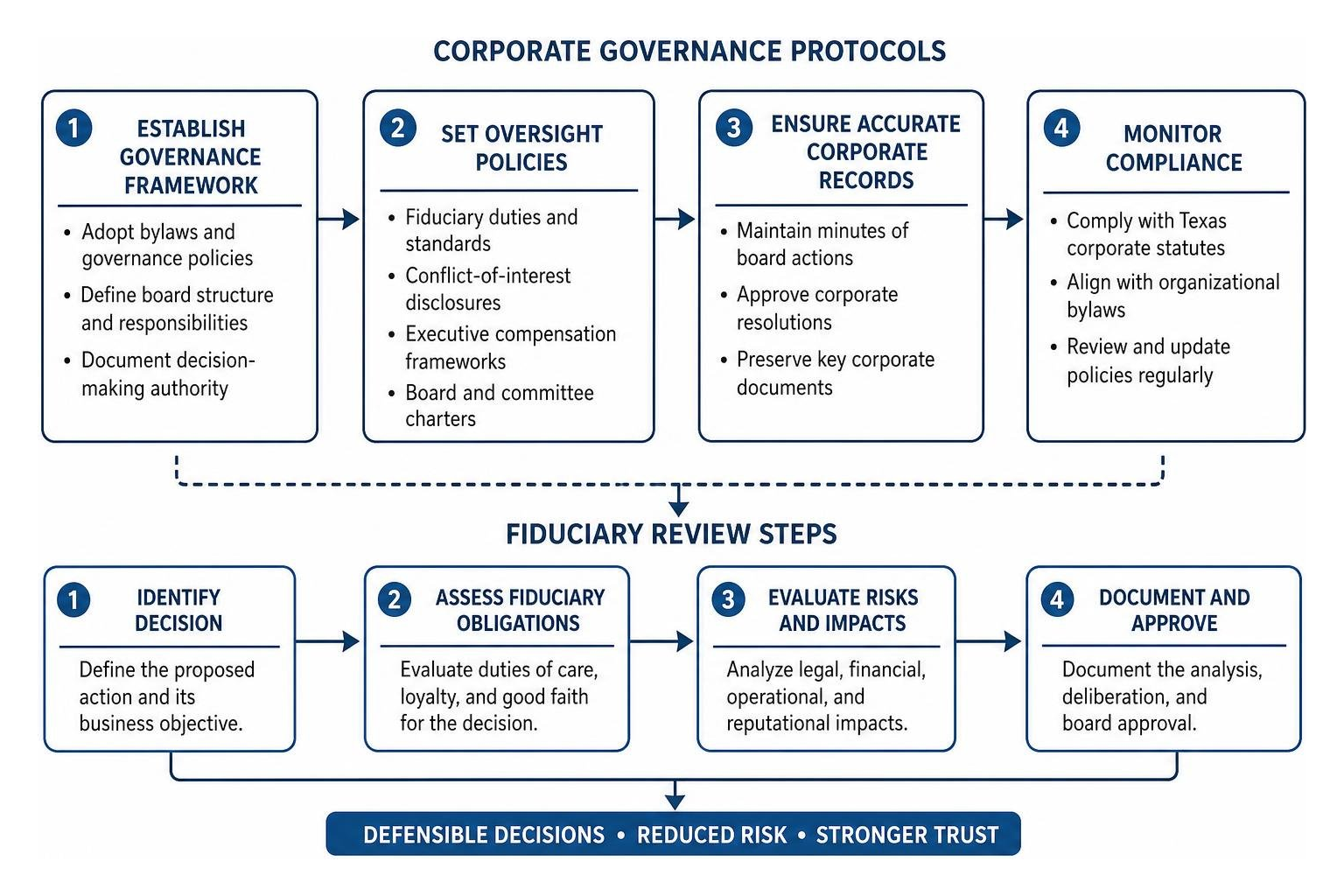
Sound corporate governance protects directors and officers from personal exposure while building institutional trust with investors, lenders, and key business partners. We assist corporate boards, advisory committees, and executive teams across Odessa and the wider Permian Basin in establishing and maintaining defensible governance protocols.
Board oversight involves clear policies regarding fiduciary responsibilities, executive compensation frameworks, conflict-of-interest declarations, and accurate corporate resolutions. When major decisions occur—such as approving substantial debt financing, issuing equity, or executing large capital expenditures—an experienced advisor ensures every board action adheres strictly to Texas corporate statutes and organizational bylaws.
Regularly updated minute books and board calendars also simplify due diligence when the company seeks capital, brings in new investors, or undergoes a change in ownership. A complete corporate record demonstrates that major decisions were properly authorized, which can be decisive in disputes seeking to pierce the corporate veil or challenge a director’s conduct.
For many West Texas companies, governance failures surface only during acquisitions or lender underwriting. Outside counsel works proactively so that board packages, approvals, and officer authorizations are aligned before a problematic transaction begins.
Essential Corporate Law and Regulatory Compliance Challenges in Odessa

Odessa’s commercial landscape is defined by energy services, industrial supply chains, logistics, commercial real estate, and rapid infrastructure expansion. This dynamic operating environment introduces complex legal requirements that demand continuous vigilance.
Companies operating in Odessa often balance master service agreements, field service contracts, equipment leases, and workforce compliance obligations at the same time. A single change in Texas employment law or environmental enforcement can ripple through those agreements. Outside general counsel maintains a current view of these obligations so that contract templates, permitting requirements, and vendor requirements are not left to chance.
Navigating Cross-Border Transactions and Regional Expansion
Expanding commercial operations beyond local borders—whether into New Mexico, across international boundaries, or through multi-jurisdictional supply networks—demands sophisticated legal structuring. Managing cross-border joint ventures, entity formations, and international supplier agreements requires a clear understanding of jurisdictional limits, tax allocations, and operational compliance.
Multi-jurisdictional growth also requires consistency in entity records, registered agent service, and tax reporting. Without that consistency, a company may accidentally forfeit its limited liability protections or create unintended nexus in another state. Counsel should review choice-of-law clauses, dispute resolution provisions, and collection rights before execution, because those terms determine where and how a future disagreement will be resolved.
Corporate acquisitions and strategic asset purchases bring distinct legal complexities. From conducting title and asset due diligence to negotiating purchase-and-sale agreements, our focus is on ensuring liability firewalls remain intact throughout every phase of regional growth.
Managing ESG Standards and Sustainability Mandates
Modern corporate governance increasingly involves environmental, social, and governance (ESG) considerations, alongside broader sustainability transparency. Middle-market and industrial companies serving institutional clients frequently face strict environmental reporting, waste management, and renewable energy mandates.
Even companies that are not subject to every sustainability reporting framework increasingly receive sustainability questionnaires from customers and lenders. A well-drafted contract allocates who bears the cost of data collection, environmental remediation, and regulatory changes. It also prevents a routine supplier relationship from becoming an open-ended indemnity.
Whether addressing Corporate Sustainability Due Diligence requirements down supply chains or navigating regional renewable integrations like industrial solar development, corporate counsel ensures commercial contracts clearly define performance liabilities and environmental indemnities.
Strategic Transaction and Risk Management Execution

Corporate risk management requires maintaining solid contractual baselines and operational controls. A thorough periodic audit protects vital enterprise value.
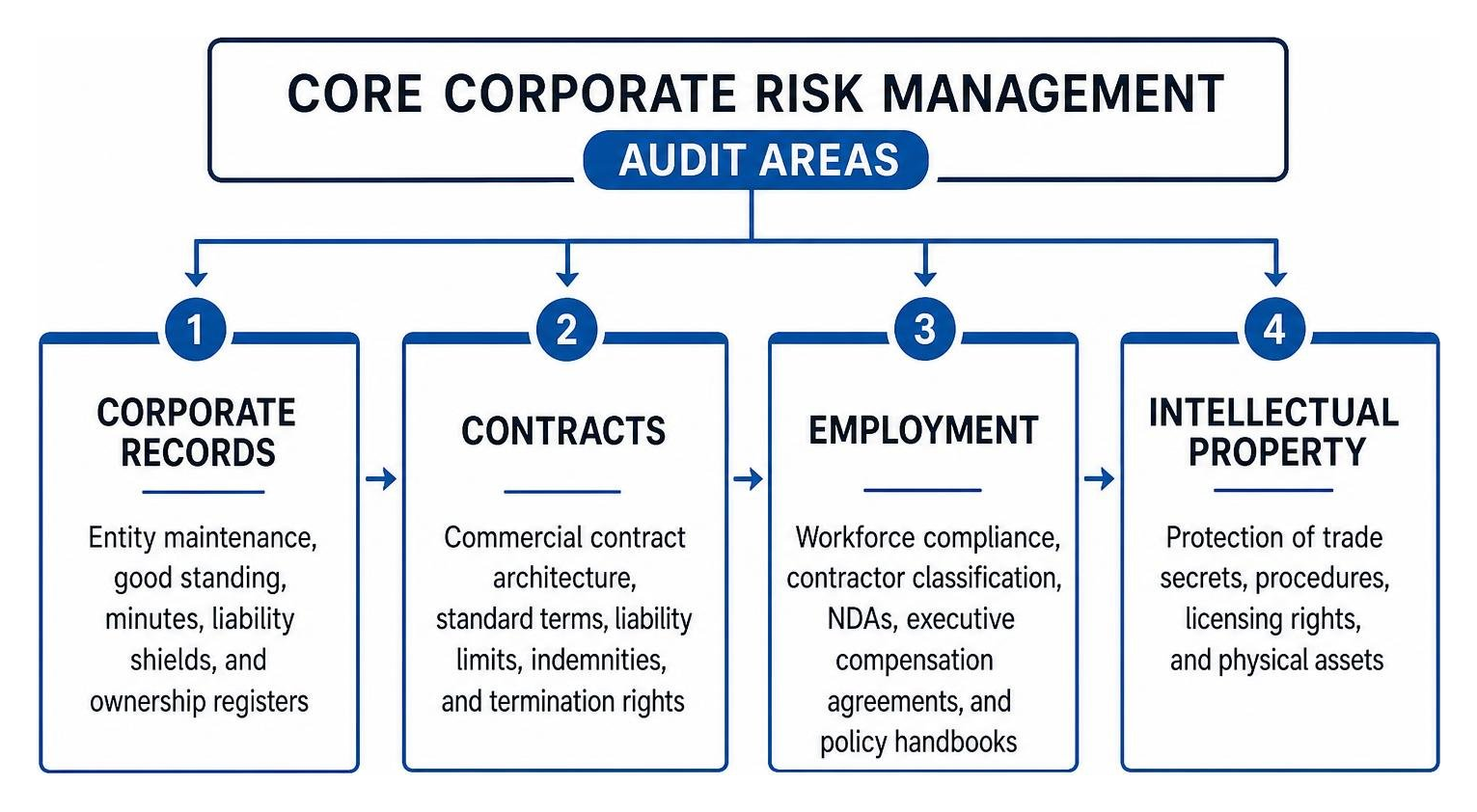
- Corporate Entity Maintenance: Regularly verifying good-standing status, annual minutes, liability shields, and ownership registers across all operating and holding entities.
- Commercial Contract Architecture: Updating standard terms, limitation-of-liability clauses, indemnity provisions, and termination rights across customer and vendor agreements.
- Employment and Workforce Compliance: Reviewing independent contractor classifications, non-disclosure agreements, executive compensation agreements, and workplace policy handbooks.
- Intellectual Property and Asset Protection: Safeguarding proprietary trade secrets, operational procedures, licensing rights, and physical assets from operational exposure.
These audits are not one-time housekeeping projects. They should be repeated when a company adds a subsidiary, enters a new service line, hires a large workforce segment, or prepares for outside investment. In each case, gaps that appear minor in isolation can weaken a company’s negotiating position or create unexpected successor liability.
How an Outside General Counsel Mitigates Litigation and Breach Risks
The most cost-effective legal dispute is the one that never enters a courtroom. By actively managing contract negotiations and pre-litigation discussions, we resolve operational friction early.
Outside general counsel uses disciplined correspondence, clear contract positions, and structured negotiation guidelines to keep disputes from becoming lawsuits. That approach includes preserving privileged communications, documenting performance milestones, and responding to default notices without admitting liability or waiving future defenses.
When a counterparty fails to meet contractual obligations or attempts to impose unreasonable indemnification demands, having an advisor who understands your operational baseline allows you to negotiate from a position of documented strength.
Frequently Asked Questions About Corporate Legal Services
What is the primary difference between in-house counsel and outsourced legal counsel?
An in-house attorney is a direct, full-time employee on your company’s payroll, which involves significant overhead in compensation, benefits, and administrative costs. Outsourced legal counsel delivers identical strategic insight, corporate leadership, and transactional execution on a flexible basis tailored to your actual operational volume. Outsourced counsel also avoids the strain that can arise when a small internal team must handle matters outside its core experience. The company can scale support up or down depending on transaction volume, without adding fixed headcount.
When should a growing business transition to dedicated fractional legal representation?
Businesses typically make this transition when they experience rapid revenue expansion, enter heavily regulated sectors, manage high volumes of recurring vendor contracts, or prepare for corporate restructurings and acquisitions. Other triggers include entering a new state or country, expanding into government contracting, or negotiating a significant credit facility. At that point, periodic review by an attorney who already knows the business is more efficient than repeatedly hiring separate law firms for each transaction.
How does external corporate counsel coordinate with specialized trial attorneys?
When formal disputes escalate, your advisory counsel provides continuity by organizing underlying evidence, evaluating contractual strengths, and collaborating directly on dispute strategy. Because the outside general counsel has maintained the company’s contracts and corporate records, the litigation team does not have to rebuild the factual record from scratch. That continuity can lower costs and strengthen the company’s position in early motion practice, discovery, and settlement discussions. If your business faces high-stakes disputes requiring dedicated courtroom representation, our firm provides aggressive Midland-Odessa civil litigation attorney services to protect your commercial interests.
Conclusion
Sustaining long-term corporate growth in West Texas requires more than reactive problem-solving. It requires a resilient corporate foundation built on sound governance, strategic risk mitigation, and proactive contract execution. At Brad J. Davidson Law Firm, PC, we leverage over three decades of business and transactional experience to provide our clients with responsive, aggressive, and highly personalized legal counsel designed to protect and accelerate commercial operations.
From entity formation to complex commercial transactions, our outside general counsel model gives leadership teams direct access to senior legal judgment without the overhead of an internal department. We help clients maintain clean records, negotiate with confidence, and respond decisively when disputes arise. With deep roots in the Permian Basin, our firm understands the operational pressures facing energy services, logistics, construction, real estate, and middle-market companies.
When disputes require courtroom representation, our team also provides aggressive Midland-Odessa civil litigation attorney representation services to protect your commercial interests.